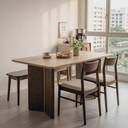
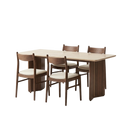
Strata Walnut & Sintered Stone Dining Table Two materials that have no business looking this good together. And yet.
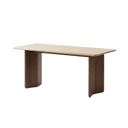
The Strata dining table is what happens when you stop choosing between stone and wood and decide to use both — correctly. A 32mm sintered stone top in Roman travertine, laid over a solid walnut substrate. A pair of 4cm flat-panel slab legs in FAS-grade black walnut, detailed with a vertical ash wood inlay. Two materials in honest conversation, each making the other look better.
This is not a walnut table with a stone veneer. It is not a stone table with wooden legs. It is a piece designed around the relationship between the two materials — their contrast in colour, texture, weight, and character — and built to hold that relationship for the long term.
The Top: Roman Travertine Sintered Stone
The tabletop is a 32mm sintered stone slab in a Roman travertine pattern — the warm, linear, slightly porous-looking stone that has defined luxury interiors from ancient Rome to contemporary Milan. Sintered stone is manufactured under extreme heat and pressure from natural minerals, producing a surface that is harder than granite, non-porous, heat-resistant, scratch-resistant, and impervious to staining.
It does not need sealing. It does not react to spilled wine, coffee, or acidic foods. It does not age the way natural stone does. What it does is look like travertine — with all the visual warmth and geological character of the real material — without any of the maintenance requirements.
At 32mm, the top has meaningful visual mass. This is not a thin slab that looks delicate from the side. It reads as substantial, the way stone should.
The Support System: Stone + Walnut, Doubled
A sintered stone top placed directly on a frame is vulnerable to flex-induced cracking — particularly at the edges and across the span between legs. The Strata addresses this with a dual-layer support system: a solid walnut substrate sits between the stone top and the leg frame, distributing load evenly across the full surface area and absorbing the minor flex that occurs in any table under daily use.
The result is a top that will not crack under normal household loading, regardless of how much weight is placed at the centre or edges. The walnut layer is structural, not decorative — it is doing real work.
The Legs: 4cm FAS Walnut Slab with Ash Inlay
The legs of the Strata are 4cm flat-panel slabs in FAS-grade North American black walnut — not turned, not tapered, not shaped. They are architectural planes that meet the floor cleanly and support the top with a geometry that is closer to contemporary sculpture than traditional furniture joinery.
Running vertically along the outer face of each leg is a fine inlay strip in contrasting ash — a lighter, more neutral hardwood that catches the eye without competing with the walnut's grain. It is the same material logic as the exposed elm dowel pins on the Senu chest: a secondary hardwood used sparingly as a signature detail, breaking the visual weight of a large walnut surface and introducing a layered depth that rewards close inspection.
The "Hawkeye" walnut used for the leg panels is a premium grain selection — sourced from North America's prime hardwood belt, chosen for the clarity and consistency of its grain figure.
Leg Clearance — Designed for Real Seating
With an inner leg clearance of 95cm (1.4m), 98cm (1.6m), and 118cm (1.8m), the Strata seats comfortably without the slab legs encroaching on chair space. The flat-panel slab format means there are no stretchers, no aprons, and no mid-leg obstructions — just clear floor-to-tabletop space between the two legs, with full freedom of movement for everyone seated along the sides.
Why Sintered Stone for a Dining Table in Singapore
Singapore's dining tables face specific challenges: high humidity cycling between outdoor heat and air-conditioned interiors, daily contact with food and liquids, and the reality that a dining table is the most used hard surface in most homes.
Sintered stone handles all of this better than solid wood, marble, or ceramic. It does not absorb moisture. It does not react to temperature change. It does not stain from curry, soy sauce, or red wine. It cleans with a damp cloth. For the dining surface specifically — the part of the table that takes the most punishment — sintered stone is the most practical premium material available.
The walnut base, meanwhile, handles the structural and aesthetic work that stone cannot do: warmth, grain character, and the visual weight that makes a dining table feel like furniture rather than a laboratory bench.
Specifications
|
|
| Collection |
Strata |
| Available sizes |
140 × 80 × 75.4cm / 160 × 80 × 75.4cm / 180 × 80 × 75.4cm |
| Inner leg clearance |
95cm / 98cm / 118cm |
| Outer leg span |
108cm / 112cm / 132cm |
| Tabletop material |
32mm Roman travertine sintered stone |
| Top support |
Dual-layer: sintered stone + solid walnut substrate |
| Leg material |
FAS-grade North American black walnut (4cm flat slab) |
| Leg detail |
Vertical ash wood inlay |
| Walnut grade |
Hawkeye selection, FAS-certified |
| Assembly |
Easy self-assembly (complimentary in-home assembly available) |
Measurements may vary ±1–3cm. Travertine pattern is a sintered stone print — each top will have slight natural variation in veining.
Pair With
The Strata pairs naturally with the Flux dining chairs — the walnut frame and upholstered seat of the Flux chair bridges the stone-and-walnut material language of the table, keeping the palette consistent while introducing a softer element at seating height.